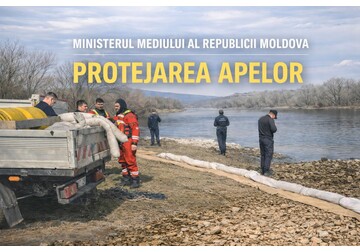
State of environmental alert has been declared in Moldova in the Dniester River basin, effective March 16
The relevant government decree was published in Monitorul Oficial (the Official Journal of Moldova) and entered into force on March 16. The decision was made based on a comprehensive risk assessment conducted by the National Crisis Management Center, the Ministry of Environmental Protection, and the National Public Health Agency, and is intended to prevent and mitigate the impact of environmental pollution and protect public health. According to the information provided, despite monitoring of the situation and the measures taken so far, there are clear signs that the pollution plume continues to move downstream, and permissible levels of petroleum products and aromatic hydrocarbons have been exceeded in the Naslavcea-Soroca area. Even if indicators temporarily return to permissible limits at certain points, the pollutant continues to arrive in waves, making it difficult to accurately predict how the situation will develop. For this reason, it was decided to move to a more active mode of managing the situation. The published government decree provides for the introduction of a 15-day state of high environmental alert in the administrative-territorial units located in the Dniester basin, including the Drochia, Soroca, Singerei, Floresti, Șoldanesti, Telenesti, Rezina, Calarasi, Orhei, Dubasari, Criuleni, and Anenii Noi districts; the municipalities of Bender, Balti, and Chisinau; administrative-territorial units on the left bank of the Dniester; as well as parts of the Briceni, Edinet, Ocnita, Donduseni, Riscani, Glodeni, Falesti, Ungheni, Nisporeni, Straseni, Hincesti, Ialoveni, Cimislia, Causeni, and Stefan Voda districts. The introduced regime allows for the intensification of technical measures, including the installation of additional anti-pollution dams and pollutant capture systems at strategically important points along the rivers. Authorities will be able to impose temporary restrictions on water abstraction and use in areas where tests show that permissible limits have been exceeded, in order to prevent contamination of water supply systems. The heightened alert status allows for the rapid mobilization of additional resources, including the use of assets from state reserves and assets not under direct state control, the engagement of additional response units, and the integration of international teams that have arrived to support Moldova under the European Union Civil Protection Mechanism. During this period, the competent authorities will ensure continuous sampling and monitoring of water quality in the Dniester, utilizing cooperation mechanisms with accredited laboratories to conduct comprehensive analyses for the presence of petroleum hydrocarbons, volatile organic compounds, and other chemicals. If pollutant levels exceed permissible limits, local authorities or operators will reduce or temporarily suspend water abstraction, ensure alternative water supply sources, and organize the distribution of drinking water to the population. The Bureau of Reintegration Policies and the Moldovan delegation to the Joint Control Commission will ensure communication and coordination of measures concerning settlements on the left bank of the Dniester, the municipality of Bender, and the perimeter of the Security Zone. All relevant state agencies and local authorities are involved in implementing the established measures. Minister of Environmental Protection Gheorghe Hajder emphasized that additional barriers will be installed at the Dubasari Reservoir in the coming days to prevent oil pollution from passing through the dam. In addition, local public authorities and private economic entities will conduct an inventory of groundwater wells, government agencies will inspect alternative water supply sources, and districts and settlements that use water from the Dniester in the Naslavcea-Dubasari section will not use water for domestic purposes for the next 48 hours. A government press release notes that this incident is not a natural disaster but a direct consequence of the war near Moldova’s borders, specifically the result of the Russian strike on a Ukrainian hydroelectric power plant on March 7. The first oil slicks in northern Moldova were detected on March 10; since then, the situation has been under round-the-clock monitoring. // 16.03.2026 — InfoMarket